 Tariform
 C&I Solar & Storage
Savings Verification
You installed solar. Do you know what you're saving?
Bill-level measurement and verification (M&V): baseline vs. actual spend for every site in your portfolio, reconciled against live tariff data every month.
The problem with solar ROI today
Operators install microgrids — then can't produce a credible savings number when finance asks.
No credible number for the board
Without a clean baseline-vs-actual comparison, you defend estimates instead of presenting data.
Savings drift goes unnoticed
Tariffs change, loads shift, underperformers blend into portfolio averages — months before anyone notices. Why a site can produce on plan yet save less →
Spreadsheet reconciliation eats analyst time
Monthly bill comparisons across dozens of sites scale badly and break quietly. One missed row changes the total.
Built for portfolio operators
Understand and communicate microgrid savings, building by building.
Portfolio-level KPIs
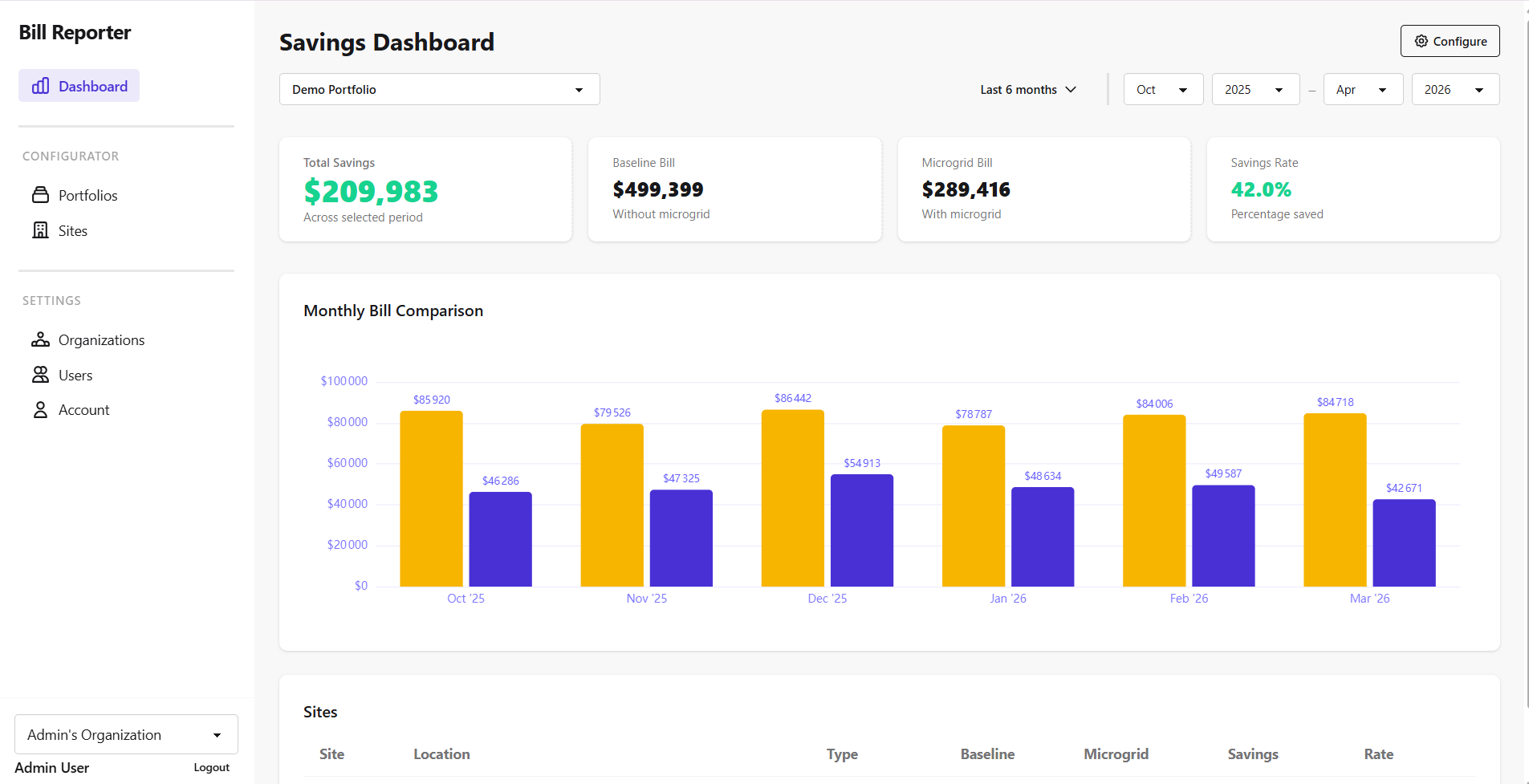
Total savings, baseline costs, and savings rate across all sites at a glance — the screen your CFO opens every month.
Site-level drill-down
Monthly bills, tariff line items, and savings deltas down to the meter.
Tariff modeling via Genability
Baseline and microgrid tariffs with custom adders and tariff-specific fields per schedule.
Automated scheduling
Monthly or quarterly recalculations run automatically — always current.
Multi-asset support
PV, BESS, and other DERs in one model per site.
Organization workspaces
Invite your team, assign roles, share context.
Frequently asked questions
How Verify calculates and reports microgrid savings.
How does Tariform calculate microgrid savings?
For each billing period, Verify computes a baseline bill — what your site would have paid on its pre-microgrid tariff against its pre-microgrid load — and compares it to the actual bill from the utility. The delta is your savings, attributable to the microgrid, line item by line item.
How does bill-level verification relate to IPMVP and traditional M&V?
Traditional measurement and verification (M&V) — IPMVP Option C, for instance — measures avoided energy in kWh, then notes that converting to dollars is hard because tariffs vary. Verify does the dollars directly: bill-level M&V that reconciles the actual utility bill against a counterfactual tariff, line item by line item. It's the financial true-up that energy-based M&V usually leaves to a footnote. More on bill verification vs. IPMVP M&V →
What is a baseline tariff and why does it matter?
The baseline tariff is the rate schedule your site would still be on if the microgrid weren't there. Choosing it correctly — same utility, same tariff structure, same applicable adders — is the single most important input for a defensible savings number. Verify lets you configure baseline and post-install tariffs independently per site. What a counterfactual bill is and how it's built →
How often are savings recalculated?
Verify can recalculate monthly or quarterly on a schedule. When utility tariffs update or new bills come in, the numbers refresh automatically — so the dashboard your CFO opens is always current.
Can Verify model PV, BESS, and other DERs together?
Yes. A single site model can combine PV, battery storage, and other behind-the-meter assets. Savings are attributed to the whole microgrid, with line-item visibility into where energy and demand charges shift.
What data do I need to onboard a site?
At minimum: the utility account, the baseline and current tariff identifiers, and historical bills (or interval data) covering your comparison window. Verify takes it from there — tariff math is powered by Genability, so you don't hand-build rate logic per site.
Does Verify support time-of-use and demand-based tariffs?
Yes. Genability-backed tariff modeling handles time-of-use windows, demand charges, tiered rates, and tariff-specific adders. You can layer custom adders on top of the catalog tariff when your contract has site-specific riders.
See last month's savings in 30 minutes
We'll configure one of your sites live and walk through the actual baseline-vs-microgrid comparison.
Not ready for a call? Email us your portfolio size and we'll send a sample report.